





Environmental monitoring programmes in pharmaceutical cleanrooms were built around intermittent sampling
and delayed culture results, yet modern manufacturing demands real-time understanding of microbial risk. As
contamination control strategies evolve toward prevention rather than retrospective investigation, biofluorescent
particle counters have emerged as a powerful upgrade to traditional viable monitoring. By delivering immediate
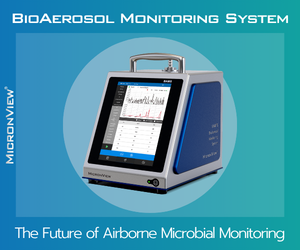
biological insight alongside conventional particle data, technologies such as the BioAerosol Monitoring System
(BAMS) are transforming how manufacturers detect, investigate and control contamination in both critical and
routine cleanroom environments.
Introduction:
Why Traditional Viable Monitoring Is No Longer Enough Environmental monitoring has always served as a foundation of contamination control in pharmaceutical manufacturing. Air sampling, settle plates and surface monitoring have historically provided the primary means of assessing microbial cleanliness in controlled environments. These methods remain essential for regulatory compliance, organism identification and long-term
trending. However, they were developed in and for an era that relied on periodic verification rather than the continuous process understanding desired in modern manufacturing.
Culture-based monitoring inherently provides delayed information. Samples must be collected at defined intervals, transported to the laboratory and incubated for several days before interpretation. By the time results are available, the production activity that generated the contamination event has already occurred. Investigations are therefore reactive, relying on historical reconstruction rather than real-time observation. In addition to the delay, traditional viable monitoring captures only isolated snapshots of cleanroom conditions. Even with robust sampling programmes, the vast majority of manufacturing time remains unmonitored. Transient contamination events, short-duration airflow disruptions or momentary operator interventions may never be detected through scheduled culture sampling alone. Modern pharmaceutical manufacturing has outgrown this approach. The rise of high-value biologics, cell and gene therapies and complex aseptic filling operations has dramatically increased the risk and cost associated with microbial contamination. A single excursion can result in significant product
loss, extended downtime, regulatory scrutiny and patient risk.